To understand which framework suits more, we should see the difference between ITIL and COBIT.
The difference were already posted in ITSM blog 2 , however after detail study of sources , i could see that there are few similarities which needs to be considered.
VR technology requires, development, testing and support of management which is entire IT service modules. Comparision between ITIL and COBIT are stated below and discussed in class.
(Integrating ITIL and COBIT 5 to Optimize IT Process and Service Delivery (.pdf) Look at ‘ITIL v3 – COBIT 5 Mapping’ processes.)
There are big overlapping of things like the primary objective in ITIL is service strategy where we understand the business goals and the same is done in governance of COBIT in evaluate direct and monitor phase, however, additional direction to goals is dealt in governance phase but cobit doesn’t address few things like financial and business relationship which are dealt in align, plan and organize phase.
Service design and transition of ITIL is similar to build, acquire and implement phase of COBIT.
Monitor phase of ITIL tasks are similar to Monitor, access and evaluate of COBIT.
Things that needs to be considered while choosing the tech are:
COBIT is generalized and can be applied in any industry , however , ITIL is more suited for IT environments only.
Scope of modules when considered, COBIT has an advantage since it covers more modules than ITIL.
COBIT primary focuses on governance modules, even though it applies both governance and stratergy and follows top-down approach. ITIL follows bottom to up approach focusing mostly on management sides of ITIL.
COBIT aligns business goals and it services with set of rules . It includes risk analysis ,resources and efficiency of it systems. ITIL manages it services and departments and provides continous oppurtunity to operate .
COBIT provides benchmarks in case of failure. ITIL uses service design and transition phase to provide resources .
Now, observing these differences and similarities as a team we compared the technology requirement and i feel COBIT as best suit but hybrid is what as a team suggested, We would like to work on hybrid structure if time permits.
challenges faced in implementing were well described and i shared with team to have a look before deciding
It is a governance and management framework for information and related technology, It is developed by ISACA and is majorly on the terms of IT Corporate Governance. For Organizations to acheive IT governance and management goals COBIT provides a comprehensive framework.
History of Cobit:
It was initially developed for audit purposes, later on several modules were added and updated to adapt by other services. Below is the chart explaining different modules which the version has concentrated on.
Currently, we are using COBIT 5 which primarily focuses on governance of enterprise IT.
Principles of COBIT
The COBIT 5 is supported on five fundamental principles:
Meet the needs of stakeholders – Understanding the business needs and objectives that needs to be fulfilled. Translate the enterprise goals in to IT relevant goals to align IT with Business. Stakeholders can be both internal and external
cover the entire organization – End to end coverage of enterprise, not restricted to IT wing alone , it considers information and relevant content as an asset that needs to be dealt with any other asset by everyone in the organization. Organization should work as an Unit rather than dissembled system.
Apply a single integrated IT governance and management model to the organization- It can integrate and align with other frameworks and best practices. It has the flexibility to adjust and overarching other frameworks.
Allow a holistic approach- defines set of enablers(policies,culture, structures of organization) to support implementation of governance and management policies by considering interacting components.
Distinguish governance from management: Governance is to achieve stakeholders need by monitoring the performance and setting of goal. It is taken care by board of directors. Management is where we plan , build, run and monitor enterprise activities with aligning to governance body. It is taken care by CEO’s and executive management.
Enterprise enablers:
Efficient and effective IT governance and management requires a holistic approach that must take into account its various components. Based on this principle, COBIT 5 defines a set of seven categories of enablers . Enablers are factors that, individually or together, influence whether something will work, in this case the corporate governance and management of IT.
The category Principles, Policies and Models are means for explaining desired behavior with practical guidelines for daily management. Processes describe a set of practices and activities to achieve certain goals that produce results to achieve those goals. Processes and activities are understood as elements that contain all the information about how, when and who makes the work flow . Organizational Structures are the decision-making entities of the organization. In the category of Culture, Ethics and Behavior are factors related to people.
The Information includes the information produced and used by the organization; At the operational level, information alone is often the main product. Services, Infrastructures and Applications are the factors that provide the organization with IT technology and services. The People, Skills, and Competencies category are people-associated resources and are essential for successful activities and proper decision making.
These last three categories of enablers are the organization’s IT resources or capabilities that must be managed and governed in a systemic and integrated manner with the other enablers. Effective management and utilization of these resources in conjunction with other practices leads to the creation of IT value, that is, each enabler needs information from others to become effective. For example, processes need information and organizational structures for skills and behaviors to be properly implemented.
The below video clearly explains the principles and enablers in layman terms
Enabling processes
COBIT has distributed the entire process in to two governance and management .Below diagram illustrate the modules covered in each.
Evaluate , direct and Monitor – are parts of governance where objectives are evaluated based on stakeholders needs , options and conditions. This sets direction of how they can be acheived and monitor the progress , performance and compliance of the objective.
Align ,plan and organize – how to align IT services to business goals and objectives. It works on how to obtain optimal results by using IT services as well.
Build, Acquire and Implement- Identification of IT requirements, acquiring required technology and implementing it with company’s business processes.
Deliver, service and support – It covers how the services needs to be delivered to business. How applications needs to be deployed in IT System and holding of support processes for efficient performance of these systems.
Monitor, Evaluate and Assess -monitor whether the companies goals are met, Evaluate the performance of the IT system and assess for improving the effectiveness of IT system.
Benifits of using Cobit 5
Accepted globally as a set of tools that ensures IT is working effectively
Functions as an overarching framework
Provides common language to communicate goals, objectives and expected results to all stakeholders
Based on, and integrates, industry standards and good practices in: –Strategic alignment of IT with business goals –Value delivery of services and new projects –Risk management –Resource management Performance measurement
Group Activities:
COBIT seems like a big module with lots of content in it. It has general terms of business but lot of components to deal with. Basil, mahesh and me worked on understanding the framework and a small brainstorming exercise was done .
Later we tried implementing with the technology and it was quite confusing. We tried to pick few processes and enablers to assist the COBIT process.
Since we were struck with project there wasn’t much time we could allocate with NET701 unfortunately and since it’s more research and irrelevant to course these doesn’t excite team much.
Reference:
Bernard, P. (2012). COBIT® 5-A management guide. Van Haren.
Pereira, C., & Ferreira, C. (2015). Identification of IT value management practices and resources in COBIT 5 / Identification of IT value management practices and resources in COBIT 5. Iberian Journal of Information Systems and Technologies, (15), 17-33. Retrieved from https://search-proquest-com.nmit.idm.oclc.org/docview/1707142482?accountid=40261
Mangalaraj, G., Singh, A., & Taneja, A. (2014). IT governance frameworks and COBIT-a literature review.
As mentioned in the previous blog, ITIL is the most used framework in business.Lets see more details of it,ITIL (Information Technology Infrastructure Library) is a framework of ITSM which standardize the planning, selection , designing and management of IT Services.
Primary goal is for increasing efficiency and gain the required service delivery. ITIL enables IT administrators to act as business service partner instead of back end support. ITIL Guides and practices help in aligning IT department actions with business needs and update them as per business growth.
History of ITIL
In 1980, Data centers were decentralized and adopted more diverse architectures more geographically for redundancy. This arised discrepancies in terms of process and deployment effecting the customer relationship.Then, United Kingdom’s (CCTA) Central Computer and Telecommunications Agency recognized the importance of noticing IT as a service and applying steady practices across IT service lifecycle and established Government Information Technology Infrastructure Management (GITIM). ITIL Version 1 was released.
In 2000, the Office of Government Commerce (OGC) released ITIL v2. ITIL v3 emerged in 2007 and later updated in 2011 for including feedback from the user and training community, and also to resolve errors and inconsistencies.
The U.K. Cabinet Office and Capita PLC formed the business in 2013. The organization’s mission is to “make individuals and organizations more effective by providing practical guidance, content and qualifications distilled from real-world experience and developing practices.”
Global best practice company Axelos currently maintains ITIL development. They announced the latest ITIL guidelines in 2017. This organization is releasing ITIL v4 throughout 2018 and 2019.
Here is a small video discussing about ITIL framework which i find the coolest of all.
Certification
ITIL Certificates
ITIL Certification provides organized expertise staff to businesses. Trainings and assessment for the level is organized by AXELOS. The below main certifications are:
Foundation: foundation course with entry level which provides overview of ITIL lifecycle concepts.
Practitioner: one step above foundation and below intermediate which allows employees to adopt and adapt ITIL in organization.
Intermediate: It consists of plenty of modules providing different focuses on IT-service management. It is not mandatory to certify in all modules for Intermediate certificate, a few would do. It provides indepth knowledge than the foundation and practitioner.
Expert: Completing 17 credits from previous certs and exam would help in gaining this , it requires knowledge on all modules and skill base in ITIL best practices.
Master: Practical examinations should be done to obtain this level certification, where selection and application of ITIL services need to be discussed.
ITIL Policies
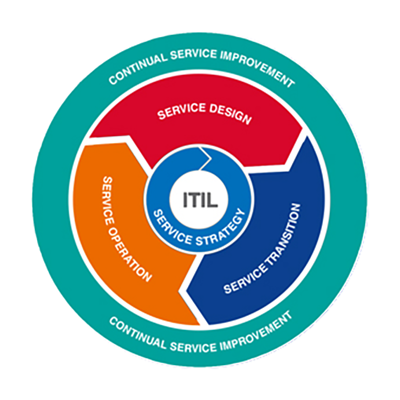
ITIL has five phases in lifecycle, which are documented in five books. This covers end to end process of Service life cycle. These volumes provide a complete guidance and process information.
Service Strategy (SS): strategy(plans, patterns to understand customer ) defines what a service provider needs to do for customer satisfaction.
Initiate how we can get there
Describe where we are
Identify where we like to be
Service Design(SD):
SD is the guidance on designing IT practices, services, procedures, and policies to provide quality service and customer satisfaction with cost effectiveness.
Infrastructure is fit for purpose
Infrastructure is fit for use
Service Transition(ST): Advises on change management for updating the current architecture and release practices for improving the service provided ; It guides admins in case of environmental interruptions and changes.
Service Operation(SO): Day-to-Day operations and management of the business’s IT services. All the strategies for services are realized through SO.
Continual Service Improvement(CSI): CSI does not mean crime scene investigation — even though this seems appropriate! It links improvement outcomes and efforts with service strategy, transition, design, and operation.
Cycle of ITIL with policies involved
In my prospective, this Animated video briefing about each policy by relating with constructing of a house is a best source to understand these concepts .
Building a new house , what to achieve is strategical decision: Service strategy
Blueprint of House, talking about money to build it, space required,Timeline of completion, suppliers availability for raw materials : Service Design
Project management expert who can assist in building new house and procure, plan duration and support for construction and evaluate efficiency , sponsor for funding: Service Transaction
Dealing with day to day updates, like buying furniture and other articles in house, house safety, Incident and service request management :Service Operation
Step wise improvement , upgrading our household articles when new technology is available in the market:Continual service improvement
Benifits:
Alignment with business needs – IT organization can proactively recommend solutions to business. Provide science offerings as per business growth.
Negotiated achievable service levels – at acceptable cost business and IT service provider can deliver the realistic service making them the true partners.
Predictable, consistent processes – Customer requirement are set and met through predictable practices applied consistently.
Efficiency in service delivery : well defined process help in attaining efficiency in terms of deploying and maintaining helping to provide healthy relationships of business and IT.
Measurable, improvable services and processes : repeated process can be monitored and automated, which results in improving of service.
A common language : Terms are defined as per both business and IT provider.
Which companies use ITIL?
Literally, companies in more than thousands worldwide and industries of all sizes and shapes has adopted ITIL. For example:
Large technology companies : Microsoft, HP, Fujitsu, IBM
Retailers : Target, Walmart and Staples
Financial services organizations : Citi, Bank of America, Barclays Bank
Entertainment entities : Sony, Disney
Manufacturers : Boeing, Toyota, Bombardier
Life sciences companies : Eli Lilly, Pfizer, Takeda Pharmaceuticals.
Since ITIL being a ‘framework’, can be adapted to suit the company’s organizational structure and requirements. It can be easily adopted across the lifecycle or inside particular process to enable IT organization a true strategic asset for business the IT supports.
Group Activities:
ITIL framework is generalized approach to issues. Since there was a lot to understand further we divided the principles among ourselves and research about them was done. Mahesh has worked on service strategy and design, basil on transition and operation. I worked on examples of implementation and continuous improvement module.
Later we had a discussion on how these can help the technology we opted which is VR.
References:
Duarte, J. C., & Lima-Marques, M. ENTERPRISE ARCHITECTURE.
Kabachinski, J. (2011). Have you heard of ITIL? It’s time you did. Biomedical instrumentation & technology, 45(1), 59-62.
Arraj, V. (2010). ITIL®: the basics. Buckinghampshire, UK.
Information technology enterprises provides IT Services to customers .A service is providing what customer needs by taking the responsibility of risk involved. Customer gives the ownership to IT Enterprise and its there duty to provide better services for better business and customer satisfaction. Management of these services through predefined standards help business to achieve better results.
What is ITSM?
ITSM stands for IT service management.The fundamental concept of how IT delivers the services to customers. It includes defining, delivering and supporting IT services.
ITSM Services
It helps in optimizing IT Services and acts like a bridge between management and IT Staff. It is supported by frameworks . Here are the few benefits of ITSM from both IT and business prospective
It ensures in increasing efficiency by managing process workflow , efficient use of resources, service based incident management and reports. It also helps to prevent from issues, bounce back from issues and provide high availability.
What is framework?
In general, framework is set of rules defined to achieve the required. Pre-defined frameworks help in providing an orderly method for implementation of ITSM.
“A process framework describes best practices that can be used to define and continually improve a given set of processes. Process frameworks also provide a common vocabulary that organizations can use when describing and executing processes .”
As per forbes Insights chart, In surveyed companies, ITSM frameworks and processes most used:
Percentage
Framework
Description
47
ITIL
Information Technology
Infrastructure Library
36
COBIT
Control Objectives for Information
and Related Technologies
36
eTom
Business process framework used by telecom
providers generally
34
MOF
Microsoft Operations Framework
ITIL
ITIL is most used among others which is a continuous improvement strategy while providing IT services. It is widely used framework . It is developed by United kingdom’s Central computer and telecommunications agency in 1989. currently Version 4, released in 2017 is being followed by organization which was updated based on business and customer feedback.
Service Strategy: defining the business goals and customer necessities and alignment of objectives.
Service Design: IT policies production, architecture and designing policies.
Service Transition: change management and release practices advices.
Service Operation: Periodic basis of IT Service which can be monthly, weekly or yearly.
Continual Service Improvement: Improve the framework for healthier efficiency.
ITIL Framework with steps involved
COBIT
It is initially developed by financial audit group but later adapted and expanded . IT stands for Controlled Objectives for Information and Technology. Created by (ISACA) Information systems Audit and control Association . It ensures quality, reliability and control of Service in an organization. cobit 4.1 consists of following steps
Planning & Organization – defines how the service should be adapted.
Delivering and Support – defining the delivery and hyper care for continuous service.
Acquiring & Implementation – defines the method of deploying and owning the service.
Monitoring & Evaluating – defines how to observe the status and evaluate the service for further improvement.
Currently, COBIT 5 was the latest framework followed by companies .It includes the following:
Principles definition and more detail of these frameworks will be defined in later blogs.
Both these frameworks are important and has distinct yet complementary goals. They do not have any blueprint to follow .However, both provide practices to adapt .
Detail study about each of these frameworks will be in forthcoming blogs.
Group Study:
ITSM frameworks were being discussed among our team . Briefing of COBIT and ITIL was done by Dimitri in class .
This assignment is most confusing since it doesn’t has to do much with the Technology rather understanding of framework and IT services are required.
As a team, we are making a list of IT services that needs to be handled and understanding what services are relevant to the technology . It was more like a brainstorming in figuring out services required for technology.
Reference:
Shahsavarani, N., & Ji, S. (2011). Research in information technology service management (ITSM): theoretical foundation and research topic perspectives. In International Conference on Information Resources Management (CONF-IRM) (pp. 1-16).
A word mostly used by IT professionals and academics .There are numerous definitions available but are not agreed on completely.Lets break the word to understand the meaning of it,
Technology:Technology is where we apply scientific knowledge to achieve something, which can be a sum of skills, processes, methods or approaches. These make human life easier and even more productive.
Emerging : Emerging means which recently entered into the market and rising in other words to become prominent .
In short , Emerging technology means a new trend of science which is uprising .
Dmitri (Enterprise infrastructure tutor) shared few definitions of Emerging technology in class and the one which driven my attention and simple to understand was “Science-based innovation that has the potential to create a new industry or transform existing ones”
Emerging Technology
During my research of understanding, I found the below more stimulating:
Mohanad Halaweh, [1] stated that emerging technology doesn’t mean new. They are tagged emerging based on domain, place or application since an old technology in developed countries can be found new in poor or underdeveloped countries. So, a technology which is not widespread and can cause a radical change to industry, business or society can be called Emerging technology (ET).
For example, extinct of DVD’s because of iPods,MP3 players, in this scenario the MP3 players and Ipods are considered as ET’s.
Examples of ET’s
Examples of Emerging technologies
Artificial intelligence, Internet of Things, VR, 3D printing, Robotics are most common ET examples as per sources like CompTIA, Techrepublic and many other sources of internet. They can be considered to be in implementing and developing phase.
Artificial Intelligence (AI):
If machines can learn and solve problems like humans, how is it gonna be? AI is all about the same. It mimics the human, developing problem-solving techniques and learning on its own. A much-recommended video, expressing lots of AI content dealing even with the branches of it in a short video.
Internet of things:
Things responses are picked and triggered as actions. Say for example if a sleeve is used to change the slide of the presentation, how will it be?Hard to believe? here is the video demonstrating how things around can be changed using IoT with the sleeve implemented.
Virtual Reality:
As a name indicates its about virtual world created around us. This has become quite popular even in the market because of VR headsets available at low prices for gaming using smartphone. Here is a video talking about difference of VR and AR. We will see more details about VR in later section.
Which technology captured my interest and why?
Virtual Reality which is an interactive computer . Using computer graphics to create a realistic world.In other words, Real time interactivity. There are 3 Is of virtual reality which is basically immersion, imagination and interaction which forms the base triangle of Virtual Reality. Inputs are received and virtual reality is updated instantaneously .
It started in 1960 where Heiling designed simulation mask to create 3D Slides. He used head mounted machines (HMD) to acheive . NASA was facing difficulties to train its astronauts, since there cannot be similar environment created,infact impossible. Using LCD’s (Liquid crystal display) placed close to eyes and tracker to detect head motion , they recreated the environment in very low budget.
These two principals are still used in todays VR head sets . An Audio , Head mounted device and glove for input sets up a VR . It is changing every field of work in to a new dimension. Architectural view can be visualized before construction, test drive, training doctors treatment for phobia’s , training police and military, treatment of mental illness .
Major players in Virtual Reality are Oculus, HTC, Sony. Video games are widely using VR technology for better user experience .
This is widely spread in market with a large application range . This helps in doing most impossible things possible for example training an astronaut by replicating a space environment in such a low budget or viewing a building before it is even constructed . Mainly doctors can practice before undergoing a critical surgeon exited me . since health care is never ending field in this world.
How to proceed further?
I have discussed my thoughts about the same with the team (Mahesh , basil and me) .Mahesh is exited are ready to implement the methods in VR Technology.
We are going to understand the ITSM Framework. Then ITIL, COBIT basics and few examples with implementations .
Assume that an enterprise is implementing the VR technology , then what practices should they implement and why ? what will be advantages.
In next post i will detail my understanding of ITSM Frameworks.
References:
Halaweh, M. (2013). Emerging technology: What is it. Journal of technology management & innovation, 8(3), 108-115.
Burdea, G. C., & Coiffet, P. (2003). Virtual reality technology. John Wiley & Sons.
Isdale, J. (1998). What is virtual reality. Virtual Reality Information Resources http://www. isx. com/~ jisdale/WhatIsVr. html, 4.
In Assignment 2, as a team of three we are going to work on deciding a best framework for technology basically cobit vs itil.
We opt an emerging technology first by compare different technologies and scope of it.
Assuming a company which is going to run business related to this emerging tech is assumed and Information technology service provider is brought in to picture.
Understanding what is IT service management we decide the modules required for running the technology.
We research and get an overview about widely used frameworks namely, ITIL and COBIT . later, compare between them to understand the best suit for technology.
In this blogging , I am going to write
1st blog is on emerging technology and selection of technology
2nd is about ITSM and services
3rd about ITIL framework
4th about COBIT framework
5th differences and observation of frameworks and which one as a team , we decide to implement.
This seems exiting and also annoying because it is going to be more a research module rather than a technical learning . It helps to adapt in business environment once we start working and would be helpful to understand work culture, however,currently , there are lot of technologies which an enterprise infrastructure is using and integration of other services with VMWare would have helped us to prepare more for market trend and a big add on to our resume rather than research module is what i personally feel.
DRS Cluster is a group of ESXi hosts , When grouped hosts in to clusters the environment becomes shared and resources are shared among VM’s. Advantages like Load Balancing , Power management and Virtual machine placement can be utilized.
Load balancing: distribute the load across resources. Vcenter server system based on criteria set on the cluster, verifies the cpu and memory utilization and provides recommendations regarding migration of Virtual machines while starting a virtual machine or when a DRS(Distributed resource system) attempts to maintain load balance.
Power management :DTM(Distributed power management) puts or recommends the hosts,VM’s to place on standby mode based on utility of VM’s and allowing other VM’s to run on the same host based on capacity available on the host and demand of cluster.
Virtual machine Placement: We can hold the placement of virtual machines based on affinity or anti affinity rules set on cluster.
In this lab , We verify and learn the features like load balancing and Virtual machine placement by creating affinity rules and load balancer.
Task1: Create a load balance
Step1: Login and migrate all VM’s VM1-2 , VM2-1, VM2-2 on to single host (use single compute resource only migration) Check on HOsts>VM’tab or by clicking each host
Step2:Ensure that all VM’s are powered on
Step3: Run CPU BUsy file in command prompt
Task2: Create a vSphere DRS Cluster
Step1: Labcluster>Settings>vSphereDRS
Step2: Edit the DRS Setting
Step3: Turn on DRS Setting and migration threshold to aggresive
Step1: LabCLuster>Monitor tab>vsphere DRS and click run DRS now
Step2: while the process is ongoing, In summary tab expand vSphere DRS Pane to check whether the state is imbalanced or not
Does the guage show that the load is imbalanced? Yes, it does since the CPUBusy processes are running on VM’s
Step3:Navigate to Monitor tab >Vsphere DRS>CPU Utilization to check the cpu’s used on ESXi hosts
Step4:Open recommendations pane in vSphere DRS or try to on any other VM to get a prompt with recommendation about migration of virtual machines and click apply recommendations
Step5:Click monitor>Tasks and events to verify whether recommendations are applied.
Step6: Click on vSphere DRS and RUN the DRS again
Is any recommendation shown? NO, SInce all are applied
Step7: Click on guage and check whether its balanced now
DOes the guage show that the load is balanced now? Yes, since the VM’s are migrated and there are hosts are not heavily loaded.
Step8: Check CPU Utilization to verify whether there is a spread across hosts and yes it is ESXi 1 is increased and 2 decreased .
Task4: Create, test and Disable a Vm-VM affinity rule
Step1: Select Lab Cluster>VM’s and then right click to adjust columns
Step2: Add host column to table for easy monitoring
Step3: CLick on settings of lab cluster
Step4: Click configure>and add VM’s host rules by clicking add
Step5: Name it as colocote-vm2-vms and check enable rule option with type as keep virtual machines together
Step6: click on Add to display VM’s where we need to verify these rules and add all VM2-1,VM2-2 and VM2-3
Step7:Click on RUN DNS and apply recommendations and view the tasks in tasks and events pane
DO you see any recommendations and why? Yes since as per the rule all the above VM’s should reside on same host and since they are not recommendations are to migrate them to single host
Step8: Verify whether VM2-1 has moved from 2 to 1 host, yes the rule is applied and moved
Step9:navigate to rules and uncheck enable rule to disable colocate rule
Task5:Create,test and disable anti-affinity rule
Step1:similar to above task name as seperate -vm2-vms and type as seperate virtual machines and add VM2-2 and VM2-3
Step2:Run DRs to check the verifications and it displays a migration recommendation since VM2-2 and VM2-3 cannot reside on same host.
Step3: Apply Recommendations and check the recents tasks bar located below to monitor the status
Step4: Navigate to VM’s pan and check the hosts and they are migrated
Task6:Create, test and disable VM-Host Affinity rule
Step1: Add a VM/Host group
Step2: Name it as VM2-Vm’s and type as VM Group and add the hosts with VM2-1 ,VM2-2 and VM 2-3
Step3: Add one more group with name VM2-host and type as host group
Step4: Add host ESXi2 to the above created host group and click ok
Step4: Create a rule name Run-Only-Host2 and select type as virtual machines to hosts
Select the VM’s group and HOsts group
Step5: RUn DRS now for recommendations
What Recommendations did vSphere DRS make and why? Since the VM’s VM2-3 and VM2-2 should be on host ESXi2 it recommended to migrate and satisy the rule created.
Step6: Apply recommendations and monitor status in tasks and events pane
Step7:We can check that VM2-3 is migrated to ESXi2 from one as per rule
Step8:Check the CPU and memory utilizations of hosts to monitor the status
Step9: Click on a VM which is on ESXi2 and migrate to 1
Step10: An error states that Host affinity rule is violated.
Step11: Open rules and disable rule
Trouble shooting:
1.Only error that i got prompted in this lab is that the recommendations got expired
Solution: rerun DRS and apply recommendations faster.
Critical Thinking:
Load balancing and placements are created and managed in this lab which is a good outcome of learning.
Load balancing helps in managing load between the resources, If in case the entire traffic is routed to single ESXi it may go down or fail which will interrupt user services helps in balancing memory and CPU load between esxi’s . Re-routing traffic to others esxi’s doesn’t only help to provide continuity in services but also in proper utilization of resources.
Placements helps in grouping and managing resources as per company . For example , an entire application resources can be grouped and placed under one ESXI which can be shutdown when the app is not needed , upgraded, migrated or in case of maintenance effecting only those VM’s. It also helps in avoiding movement of VM’s to ESXi’s where the resources are insufficient to run Virtual machines.
HA is High Availability service provided by VMWare, where resources are grouped in to a cluster, in case of any breakdowns of ESXi’s automatically, cluster triggeres and the VM’s will be migrated to another ESXi to resume the availability of resources. This helps in providing customers a continuous application services.
In this lab, we create a cluster and move our ESXi resources to it. Then We shutdown Master ESXi and verify how the post process works in HA. A dedicated switch is required for HA service .
Later, we change the resources reservation and check the effects on other hosts.
Task1:Create a cluster Enabled Vsphere HA
Step1:Select Dataceneter in Hosts and clusters and click New cluster
Step2: Check Vsphere HA ON and name as Lab Cluster
Step3: Verify in the status bar for cluster is created
Task2:Add your ESXi Host to cluster
Step1:Drag both ESXi’s to cluster
Step2: Click on LabCluster >Monitor tab>Vsphere HA to view the master client – 172.20.10.51
Step3:View heartbeat through which datastores checks are configured
Step4: navigate to Monitor> issues tab where issues are listed
Step5:Navigate to VMKernel Adapters and click on Vmotion adapter
Step6: Check Management service to enable it
Step7: repeat the same to ESXi2
Task3: Test vSphere HA Fuctionality
Step1: Click on ESXi and select reconfigure for vsphere HA on both the ESXi’s
Step2: verify that both the issues are resolved
Step3:Makesure one virtual machine is turned on On Master client
Step4: reboot the master client
Step5: Give reason as Testing Vsphere HA
Step6: The master client changes from 172.20.10.51 to 172.20.10.52
Since my VCSA is on ESXI1 (Master) so we are rebooting ESXi2
Step7: Different Events are triggered which can be monitored in Tasks and Events tab
Step8:All the VM’s are moved from ESXi2 to ESXI1 (Navigate to ESXI and VM’s tab)
Task4: View the Vsphere HA CLuster Resource Usage
Step1: Navigate to Hosts and clusters>Select Lab cluster>Monitor>Resource reservation to check cluster capacity
Step2: Select VM’s tab and check the reservations of VM’s will be set to 0MHz
Task5: Manage Vsphere HA SlotSize
Step1:Move to Configure tab and select vsphere availability and click edit
Step2: Select Admission control and change Define failovercapacity to SLot Policy and OK
Step3: Navigate to VsphereHA Summary to check the Slot Size and Total Slots in cluster
Step4:Select VM2-2 >EditSettings
Step5: expand CPu and increase reservation to 512Mhz
Step6:Navigate back to Vsphere HA and check Advance runtime info which increased from 32 to 512 since the reservation is set
Step7: LabCluster>Settings
Step8: Admission Control> Select Fixed Slot Size
Step9: Change CPU SLotSize to 300 and memory slot to 82 and click calculate which gives 1/3 slots required…which means the 512HZ CPu will use 3 CPU’s to power on
Step10: View the updated Memory and CPu in Vsphere HA Tab
Step11: Remove the HA Fixed slot Setting LabCluster>Settings>vsphere Availability>Edit>Admission Control> Define Host failover Capacity by>Cover all Powered on Virtual machines
Step12:Remove the reservation by expanding VM> expand CPU and Reservation to 0
Task6: Configure a Vsphere HA with administrative control
Step1: Turn off VM2-3 and all virtual machines
Step2: Navigate to Monitor>Resource reservation>Memory, the available reservation is less than total
Step3:Assign 300 MB reservation for VM2-1 by expanding Memory option of VM
Step4:Navigate to VsphereHA tab>Summary in monitor
Step5: Navigate to VM2-1 and power on and check monitor tab the memory utilization goes down to 27(Half of assigned)
Step6: Right click VM1-2 and start the VM , It will through an error stating resources are insufficient
Task7:Prepare for Next lab
Step1: Remove the reservation from VM2-1
Step2: Edit cluster settings>Admission Control>Failover capacity to disabled
Trouble shooting: The lab was complex but straightforward, which can be attained but pre-requisistes like switches should be of same name, Network of hosts in different ESXi’s should be in sync and HA service enabled VM Kernel adapter should be used are must.
Critical thinking: This lab is little annoying since, many objectives were discussed, HA triggering was simple and concise but Cluster management has lot of options and admission controls resource monitoring were also included in this part of lab making it difficult and hectic.
However, in Business High availability is must to provide better and continuous customer service, even though the VMWare HA is not instant (The resources take time to migrate and poweron in other ESXI service) it is easy to configure and time depends on VM hardware size. So,based on VM Size the architecture should be maintained,grouped and configured to avoid delayed services.
Virtual machines hosts are similar to physical machines which are hosted on ESXi Host (like a data in software). Wait, does this mean can the data i mean the Host recoverable in any case? The answer would be NO, If we delete the VM from the disk the resource files are also deleted but if we just delete from inventory, the data still exist and can be recovered as VM.
Snapshots are image of instances at that particular point of time. Can be considered as full backup of resource. we can restore to any snapshot at any point of time, with out any difficulties.
In this lab. we observer the difference between the deletion from Inventory and disk and then create different snapshots and restore at different intervals.
Task1: Unregister a virtual machine from a VCenter Appliance Inventory
Step1:VMs and Templates>VM2-3 >DataStores tab and check the storage: Shared-ISCSI-VMFS
Step2: Power off and click remove from inventory
Step3: Confirm for removal
Step4: Navigate to datastore and verify the VM
Does folder name VM2-3 exist?
Since the hot-clone VM is renamed as VM2-3 the datastore will always be with default first name which is hotclone
Task2: Register a virtual machine in the vcenter server Appliance Inventory
Step1: Click Hotclone.vmx file in datastore and rightclick to register VM
Step2: Select the Name and location to store the VM
Step3: Select ESXi1 and with default options finish
Step4: verify the VM2-3 created in LABVMs folder
Task3:Unregister and delete Virtual Machine from the Datastore
Step1: Select VM-FromLab and click delete from the disk
Step2: Verify in the datastore whether the datafiles are deleted or not
Task4: Take Snapshots of a virtual machine
Step1: Login to VM1-2 machine and drag IOMeter to recyclebin
Step2: Rightclick and select empty recycle bin
Step3: Take Snapshot by right clicking on VM and snapshots> takesnapshot
Step4:Name snapshot as “without IOMeter”
Step5:Login to VM1-2 and drag the CPUBusy file to recycle bin
Step6:Rightclick and empty recycle bin
Step7: Rightclick the VM and click Take Snapshot
Step8: Name it as Without IOMeter and CPUBusy
Step9:Select the Class-Vsphere ISO in the CD Drive from NFS DATaStore
Step10: Click on expand CD/DVD and Select Datastore ISO FIle
Step11: Open CD Drive in VM1-2
Step12: Drag CPUBusy to Desktop
Step13: Select Snapshots >Take Snapshot
Step14: Save it as withCPUBusy and description as added CPUBUsy
Step15:Click on Manage Snapshots
Step16: To Revert follow next step
Task5:Revert to Virtualmachine to a snapshot
Step1: Select All actions>revert to
Did the Virtual Machine power off and why? Yes since the memory state was not preserved .
Step2:Verify wheter ISO Meter and CPUBusy is on desktop? It wont be there since the snapshot we redirected to doesn’t have them .
Step3:Click on all actions revert to and select with cpubusy
Did the virtual machine poweroff and what is the reason? No Since it has preserved memory state .
Step4: Login to Console and verify whether CPU Busy is on desktop
IS CPUBusy on the desktop? – Yes it is since the old snapshot has
Is IOMeter on the desktop?No
Task6: Delete an individual Snapshot
Step1: Select VM>Actions>Manage snapshots
Step2: Select withoutIOMeter and CPUBusy and click on delete snapshot in actions
Did the virtual machine poweroff? No, it didn’t since it doesn’t have any effect on VM.
In the virtual machine console , is the CPU Busy file on the desktop? yes, since deleting snapshot will not effect the state of VM. It only removes an option to point back to that particular point of time.
Step3: Confirm deletion
Task7: Delete all Snapshots
Step1: Rightclick VM1-2 >Snapshots>Delete all Snapshots
Step2:Confirm by clicking yes.
Were all the remaining snapshots deleted from the tab? Yes they are all grouped and removed from the system
Step3: Login to console and verify whether CPU Busy is on Desktop
Is CPUBusy on the desktop, and why? Yes, Since there are no changes made to machine after the reversion.
Troubleshooting: This was direct lab, with simple clicks . Since we are handling a nested VM Situation, uploading data inside the VM had issues, we need to upload the data in to local datastore ,then ESXi and by setting the VM host CD/DVD as Host device, we are able to upload the documents.
Critical Thinking: Snapshots consume lots of data ,however they are best available options for full restore of instances. While building an architecture by setting milestones and taking snapshots help to reduce redoing of things.
Apart from this, in a business scenario, before new changes are added to system, snapshot is preferred, since we can restore and resume the applications without any issues ,thus helps to maintain VM environment healthy.
Naming convention should be highly considered and maintained , since the updation of VM name is not possible on disks, recovering from the disk at later stages would be confusing and annoying. A subversioning tool must be maintained with the names of the VM’s to avoid such issues.




 Net701: Enterprise Infrastructures