
Objectives:
- ITIL Introduction
- History of ITIL
- Certification of ITIL
- ITIL Policies and description
- Benefits
- Companies using ITIL
Introduction
As mentioned in the previous blog, ITIL is the most used framework in business.Lets see more details of it,ITIL (Information Technology Infrastructure Library) is a framework of ITSM which standardize the planning, selection , designing and management of IT Services.
Primary goal is for increasing efficiency and gain the required service delivery. ITIL enables IT administrators to act as business service partner instead of back end support. ITIL Guides and practices help in aligning IT department actions with business needs and update them as per business growth.
History of ITIL
In 1980, Data centers were decentralized and adopted more diverse architectures more geographically for redundancy. This arised discrepancies in terms of process and deployment effecting the customer relationship.Then, United Kingdom’s (CCTA) Central Computer and Telecommunications Agency recognized the importance of noticing IT as a service and applying steady practices across IT service lifecycle and established Government Information Technology Infrastructure Management (GITIM). ITIL Version 1 was released.
In 2000, the Office of Government Commerce (OGC) released ITIL v2. ITIL v3 emerged in 2007 and later updated in 2011 for including feedback from the user and training community, and also to resolve errors and inconsistencies.
The U.K. Cabinet Office and Capita PLC formed the business in 2013. The organization’s mission is to “make individuals and organizations more effective by providing practical guidance, content and qualifications distilled from real-world experience and developing practices.”
Global best practice company Axelos currently maintains ITIL development. They announced the latest ITIL guidelines in 2017. This organization is releasing ITIL v4 throughout 2018 and 2019.
Here is a small video discussing about ITIL framework which i find the coolest of all.
Certification

ITIL Certification provides organized expertise staff to businesses. Trainings and assessment for the level is organized by AXELOS. The below main certifications are:
- Foundation: foundation course with entry level which provides overview of ITIL lifecycle concepts.
- Practitioner: one step above foundation and below intermediate which allows employees to adopt and adapt ITIL in organization.
- Intermediate: It consists of plenty of modules providing different focuses on IT-service management. It is not mandatory to certify in all modules for Intermediate certificate, a few would do. It provides indepth knowledge than the foundation and practitioner.
- Expert: Completing 17 credits from previous certs and exam would help in gaining this , it requires knowledge on all modules and skill base in ITIL best practices.
- Master: Practical examinations should be done to obtain this level certification, where selection and application of ITIL services need to be discussed.
ITIL Policies
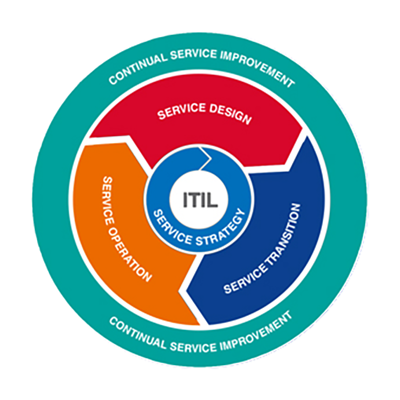
ITIL has five phases in lifecycle, which are documented in five books. This covers end to end process of Service life cycle. These volumes provide a complete guidance and process information.
- Service Strategy (SS): strategy(plans, patterns to understand customer ) defines what a service provider needs to do for customer satisfaction.
- Initiate how we can get there
- Describe where we are
- Identify where we like to be
- Service Design(SD):
- SD is the guidance on designing IT practices, services, procedures, and policies to provide quality service and customer satisfaction with cost effectiveness.
- Infrastructure is fit for purpose
- Infrastructure is fit for use
- Service Transition(ST): Advises on change management for updating the current architecture and release practices for improving the service provided ; It guides admins in case of environmental interruptions and changes.
- Service Operation(SO): Day-to-Day operations and management of the business’s IT services. All the strategies for services are realized through SO.
- Continual Service Improvement(CSI): CSI does not mean crime scene investigation — even though this seems appropriate! It links improvement outcomes and efforts with service strategy, transition, design, and operation.
In my prospective, this Animated video briefing about each policy by relating with constructing of a house is a best source to understand these concepts .
- Building a new house , what to achieve is strategical decision: Service strategy
- Blueprint of House, talking about money to build it, space required,Timeline of completion, suppliers availability for raw materials : Service Design
- Project management expert who can assist in building new house and procure, plan duration and support for construction and evaluate efficiency , sponsor for funding: Service Transaction
- Dealing with day to day updates, like buying furniture and other articles in house, house safety, Incident and service request management :Service Operation
- Step wise improvement , upgrading our household articles when new technology is available in the market:Continual service improvement
Benifits:
- Alignment with business needs – IT organization can proactively recommend solutions to business. Provide science offerings as per business growth.
- Negotiated achievable service levels – at acceptable cost business and IT service provider can deliver the realistic service making them the true partners.
- Predictable, consistent processes – Customer requirement are set and met through predictable practices applied consistently.
- Efficiency in service delivery : well defined process help in attaining efficiency in terms of deploying and maintaining helping to provide healthy relationships of business and IT.
- Measurable, improvable services and processes : repeated process can be monitored and automated, which results in improving of service.
- A common language : Terms are defined as per both business and IT provider.
Which companies use ITIL?
Literally, companies in more than thousands worldwide and industries of all sizes and shapes has adopted ITIL. For example:
- Large technology companies : Microsoft, HP, Fujitsu, IBM
- Retailers : Target, Walmart and Staples
- Financial services organizations : Citi, Bank of America, Barclays Bank
- Entertainment entities : Sony, Disney
- Manufacturers : Boeing, Toyota, Bombardier
- Life sciences companies : Eli Lilly, Pfizer, Takeda Pharmaceuticals.
Since ITIL being a ‘framework’, can be adapted to suit the company’s organizational structure and requirements. It can be easily adopted across the lifecycle or inside particular process to enable IT organization a true strategic asset for business the IT supports.
Group Activities:
ITIL framework is generalized approach to issues. Since there was a lot to understand further we divided the principles among ourselves and research about them was done. Mahesh has worked on service strategy and design, basil on transition and operation. I worked on examples of implementation and continuous improvement module.
Later we had a discussion on how these can help the technology we opted which is VR.
References:
Duarte, J. C., & Lima-Marques, M. ENTERPRISE ARCHITECTURE.
Kabachinski, J. (2011). Have you heard of ITIL? It’s time you did. Biomedical instrumentation & technology, 45(1), 59-62.
Arraj, V. (2010). ITIL®: the basics. Buckinghampshire, UK.
 Net701: Enterprise Infrastructures